
Celine Song's Balenciaga Campaign: Meta on Meta on Meta
What it Taught Me About My Own Work

I watched Celine Song’s Balenciaga campaign, A New York Minute, over and over. Three one-minute films. The same street. The same woman. Morning, day, night.
Watch the Balenciaga Campaign Here
The first time, I was inside it. I was Sarah Pidgeon, alone on cobblestone. I recognized that feeling — that private-public aloneness of being in my own world in a city of millions. Then the frame widened and I saw the crew, the camera, the direction, the instruction to keep rolling. I was no longer her. I was part of the crew watching the feeling being constructed. By the end, I was neither. I was a passerby who had wandered into someone else’s movie, briefly aware that my ordinary day had become part of something being made.

(from @balenciaga)
Three ways into the same sixty seconds. And I have not been able to stop thinking about it.
Even the campaign’s Instagram handle — @keeppprolling — suggests that we are always being watched.
For me, another Easter egg — whether deliberate or not — was the vertical film within a film featuring ReelShort star Chris Quartuccio. I see you, Chris. IYKYK. I do not know how intentional the casting was of a familiar face from a vertical platform inside a campaign designed to circulate vertically on social media, but to those of us watching the vertical space, it added another layer. The campaign was not only about a woman being filmed in New York. It was also about formats watching each other: cinema, fashion film, social video, vertical drama, behind-the-scenes content, and the viewer moving between all of them.
I usually think of meta as distance. The wink. The parody. The moment a film turns around to remind us that it knows it is a film. Meta as the God voice — the work stepping outside itself to signal its own awareness.
What Song does is the opposite. She uses the reveal of the crew, the monitor, the instruction to keep rolling — not to break the spell, but to deepen it. The moment we see the production around Sarah Pidgeon, we do not feel tricked. We feel implicated. We are no longer simply watching a beautiful image. We are inside the act of making one.
That, to me, is meta as intimacy. It does not say: this is fake. It says: this feeling was made — and now you are in it.
I know A New York Minute is branded content — I know this because I own a twenty-year-old Balenciaga Ink Moto Bag, my divorce gift to myself, and I still believe in that feeling when I bought it. And I know A New York Minute and Ex-Wives of Beverly Hills are not the same scale or the same conversation. But watching Song use the reveal of the apparatus to pull the viewer closer rather than push them away clarified something I had been trying to name. Ex-Wives was already living inside that idea. This framework gave it clarity.
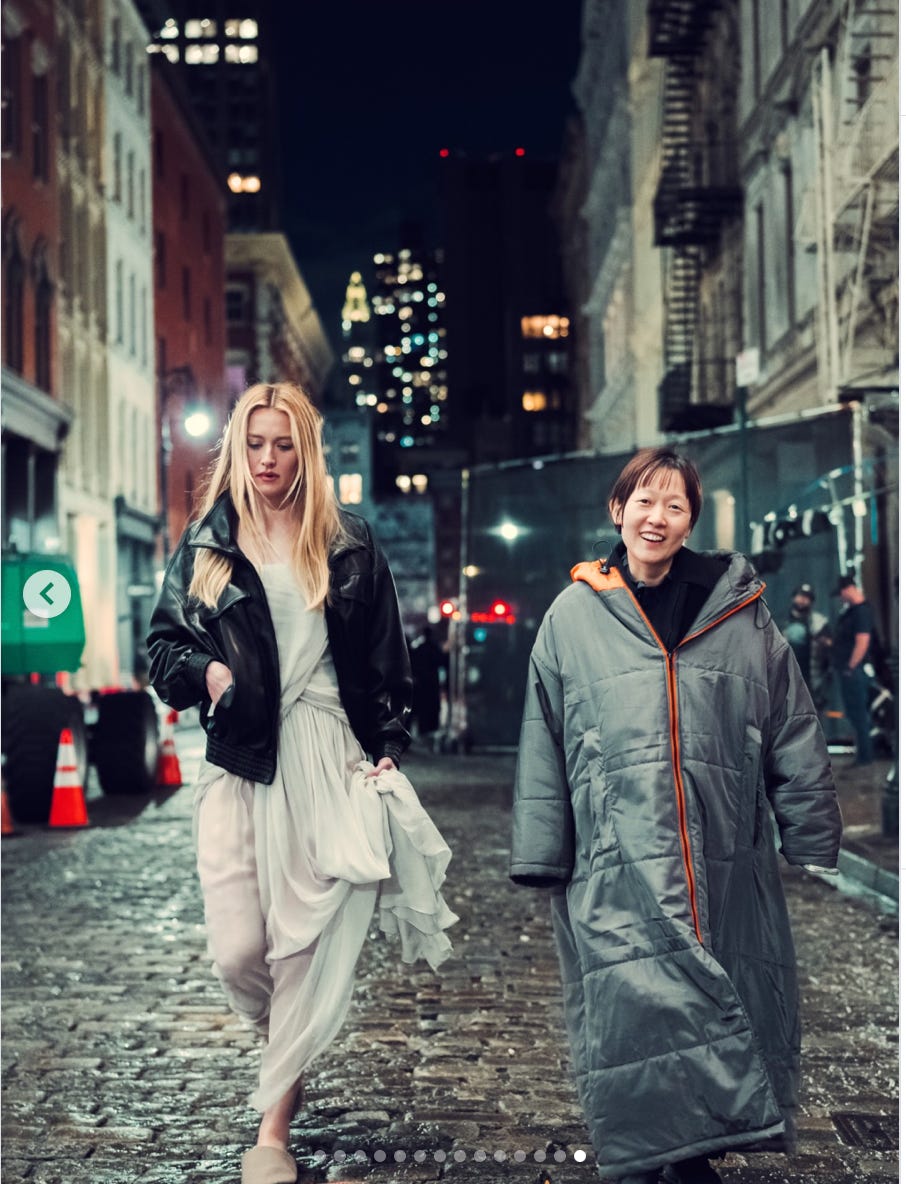
(from @balenciaga)
That is why I could not stop thinking about The Ex-Wives of Beverly Hills, the comedy pilot I directed and co-created with my friend Nicole Hansen.
[Watch the Ex-Wives of Beverly Hills trailer here.]
Because what Song captures in three elegant minutes on a cobblestone street, we are all living in full-time. We are in a surveillance culture now — Ring cameras, phone cameras, social media, the ambient sense of being documented whether we choose it or not. Ex-Wives is not just a show that uses cameras as a storytelling device. It is a show about what happens to women who are performing, whether they know the cameras are there or not. When you cannot separate the life you are living from the version of it that is being recorded.
Ex-Wives began as parody. A comedic riff on the docu-follow format — Real Housewives gloss, over-the-top drama, midlife meltdowns played for laughs. Parody gave us the surface: the house, the women, Beverly Hills as a pressure cooker. But parody keeps the audience at a comfortable distance. It says: look how ridiculous this is. And I did not want distance. I wanted the opposite.
So the show moved toward mockumentary — and with it came a more interesting question: what does it mean to watch someone manage her own image while the cameras keep rolling? In a traditional mockumentary, the camera threads the story through confessionals and interviews — The Office, Abbott Elementary, Modern Family. The characters step out of the action to tell us what it meant. But stepping out of the action is still a form of distance. I did not want the viewer to feel like an audience member being given an explanation of what they just saw.
I want the feeling of someone who had wandered into the production of someone else’s life.
I began to think of Ex-Wives not as parody, not as mockumentary, but as constructed-footage comedy. The format has been explored in horror and thriller, in films built from device screens and surveillance footage. I asked myself: what happens if you bring that same instinct into comedy? Into an ensemble of women? Into Beverly Hills, where the surfaces are glossy and the lives are curated?
That question also connected to what I was seeing in vertical storytelling. My son Ethan’s ReelShort film Point Dume — which won a Student Filmmaker Award from ReelShort and features Chris Quartuccio alongside a Gen Z cast — reminded me how native this instinct already is to younger filmmakers. His characters are influencers; the footage is their own, performed and accidental at the same time. They are already living inside the camera. Watching social native creators work this way gave me permission to follow that thread to Gen X — to ask what pressure looks like for women in their 50s, in Beverly Hills, when the cameras never stop and the image they have built is exposed.
Ex-Wives of Beverly Hills is a constructed-footage ensemble comedy about women whose lives become impossible to separate from the cameras supposedly documenting them. Not a mockumentary. Not a parody. The cameras in this world are already there: the wedding videographer hired to preserve the fantasy, the phones that record everything, the Ring cameras that capture too much, the social posts that turn humiliation into content. The apparatus is never invisible — and it is never the joke. It is the architecture.
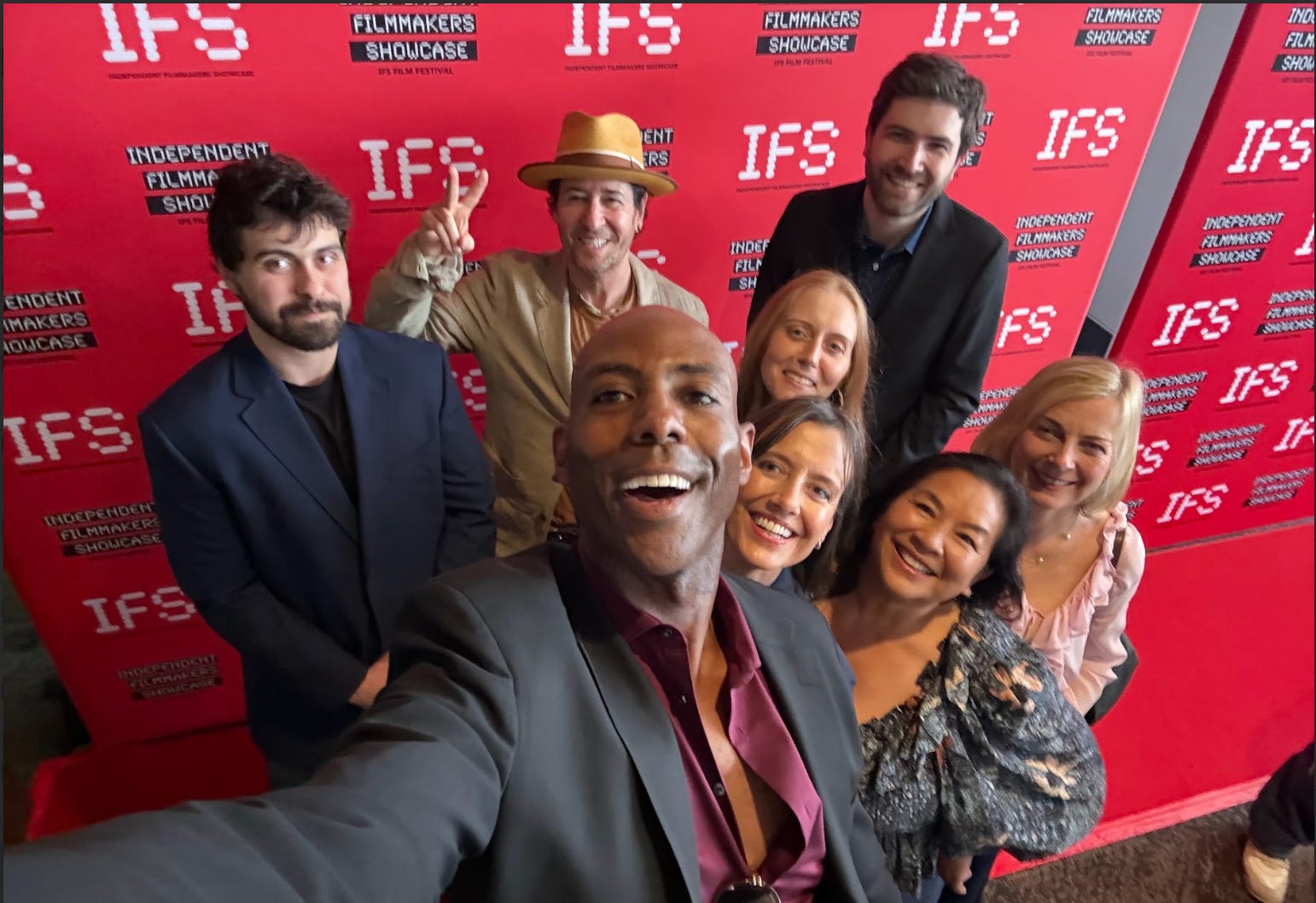
(photo courtesy of DP James Markham Hall, Jr (center) (clockwise) AD and Editor, Nikos Spiradakis, actor Rob Morrow, line producer Alastair Shearman, Post-Supervisor Tina Brettschneider, Best Actress Debbon Ayer, me, Co-Creator, Producer and actor Nicole Hansen)
The meta quality of Ex-Wives is intimacy. The viewer is not outside the story looking down on these women. The viewer is implicated in the act of watching them. We see the image they are trying to create, and we also see the moments when that image fails. The comedy lives in that gap — between the life the women are trying to stage and the life the cameras reveal.
The scenes were scripted with a clear emotional shape and a destination, but the actors were given room to find how they got there through improv. That looseness was essential. The performances are messy, overlapping, full of uncomfortable silences and true reactions no one planned. In the space between the written beats, something less controlled can emerge. Those are the moments that make a viewer lean in because they are recognizable.
I want the audience to enter Ex-Wives the way one enters any beautiful constructed world: seduced by the surface, then gradually aware of the machinery underneath. The aspiration matters. The beauty matters. The fantasy matters. But the show begins after the planned image collapses, when the cameras keep rolling and the women have to decide whether the footage will expose them, trap them, or finally let them be the protagonist of their own life.
It was built around women in their 50s — divorced, competitive, fabulous, wounded, and funny — who are not side characters in someone else’s story. They are the story. The show is about female friendship, where love and resentment live in the same room. Where women who were taught to compete for men, beauty, status, and relevance are forced to confront the fact that the only people who truly understand them are each other.
Watching Song’s campaign reminded me that the reveal of the apparatus does not have to destroy the feeling. Sometimes it is the only way to let the viewer fully inside it. It helped me use familiar grammar — cameras, footage, performed ease — to get somewhere more honest, and to laugh at ourselves when honesty becomes unbearable.
That is what three one-minute films on a cobblestone street in New York taught me about my own show.
Ex-Wives of Beverly Hills (@exwivesbh) recently won Best Episodic, Audience Award for Best Short Film, and Best Actress for Debbon Ayer at the IFS L.A. Film Festival (@ifs.film.festival), and Best Web Series Pilot and Best Producer for Nicole Hansen from the LA Independent Women Film Awards (@laindependentwomenfimawards).
Eda Benjakul is an award-winning filmmaker, director, and co-creator of The Ex-Wives of Beverly Hills. She is a Sundance Episodic Lab Finalist and Stowe Story Lab Fellow for the drama pilot Star of Siam, LA News Emmy-nominated and Daytime Emmy Award-winning producer.